







$172,250 per year is the median MR Physicist salary ($82.81 per hour). Board-certified clinical roles average $246,600 per year.
Table of contents
- MR Physicist Salary Overview
- How Experience Shapes MR Physicist Pay
- MR Physicist Salary by State and Geographic Region
- How Work Settings Impact Pay
- Employment Type and Shift Differentials
- Certifications and Specializations That Boost Earnings
- Pay Outlook for 2026 and Beyond
- Concrete Steps to Increase Your MR Physicist Pay
- About the Job: What an MR Physicist Does
- Frequently Asked Questions
- Data Sources and Reference Periods
The median MR Physicist salary in the United States sits at $172,250 per year, which translates to an hourly rate of $82.81 per hour. However, compensation spans a wide spectrum depending on clinical credentialing, practice setting, and technical scope. Across the broader physics workforce, annual earnings range from $82,110 at the 10th percentile for early-career researchers up to $274,110 at the 90th percentile for senior experts. Board-certified clinical MR physicists in healthcare systems often pull in substantially more: clinical medical physicists specializing in imaging average $246,600 annually according to medical physics workforce surveys.
MR Physicist Salary Overview
To evaluate how much an MR Physicist earns across different career stages and sectors, the table below compiles baseline benchmark figures from the federal government and professional societies.
Metric | National Figure |
|---|---|
Annual Median Pay | $172,250 per year |
Hourly Median Pay | $82.81 per hour |
10th–90th Percentile Range | $82,110 – $274,110 per year |
25th–75th Percentile Range | $111,720 – $222,760 per year |
Board-Certified Clinical Average | $246,600 per year |
Top-Paying State (Median) | Florida ($225,390 per year) |
Total U.S. Employment (Physicists) | 20,430 |
Job Outlook (2025–2035) | 7% growth (faster than average) |
Sources: U.S. Bureau of Labor Statistics (OEWS, May 2025) for SOC 19-2012 Physicists; American Association of Physicists in Medicine (AAPM Professional Survey, CY2024).
How Experience Shapes MR Physicist Pay
A fresh graduate out of a Master's or doctoral program starts on a very different pay band than an experienced Qualified Medical Physicist (QMP) leading MRI quality assurance across a hospital network. In the physics field, salary percentiles map closely to career seniority and board certification status.
An entry-level MR Physicist salary typically reflects postdoctoral fellowship pay or junior non-certified physicist roles, landing near the 10th to 25th percentiles. Once a physicist completes a CAMPEP-accredited residency and passes board exams, compensation jumps markedly. Mid-career MR physicists running routine clinical scanner acceptance tests, implant safety evaluations, and pulse sequence optimization sit near the median or above. Senior physicists overseeing multi-center imaging networks, MR-guided radiotherapy (MR-Linac) programs, or university research cores reach the top tenth percentile.
Career Level | Experience & Milestones | Typical Annual Pay | Equivalent Hourly Wage |
|---|---|---|---|
Entry-Level (10th Percentile) | Postdoc / Junior Fellow / Pre-residency (0–2 years) | $82,110 per year | $39.48 per hour |
Early-Career (25th Percentile) | Residency Graduate / Board-Eligible (2–4 years) | $111,720 per year | $53.71 per hour |
Mid-Career (50th Percentile / Median) | Board-Certified Staff Physicist (5–9 years) | $172,250 per year | $82.81 per hour |
Experienced (75th Percentile) | Senior Clinical / Specialist Physicist (10–14 years) | $222,760 per year | $107.10 per hour |
Senior / Lead (90th Percentile) | Lead MR Physicist / Imaging Director (15+ years) | $274,110 per year | $131.78 per hour |
MR Physicist Salary by State and Geographic Region
Geographic location drives notable differences in how much a MR Physicist makes. Coastal biotech hubs and major academic health systems tend to offer the highest raw salaries to offset elevated housing costs, while states with high concentrations of specialty medical networks also pay premium wages.
According to federal wage reports for physicists, Florida reports the highest median wage at $225,390 per year, supported by large regional health systems and specialized cancer treatment networks. States like California, Massachusetts, Arizona, and New Mexico also command strong compensation packages due to heavy research infrastructure, national laboratories, and dense medical school clusters.
State | Average / Median Annual Pay | Average Hourly Rate | Key Market Drivers |
|---|---|---|---|
Florida | $225,390 per year | $108.36 per hour | Large hospital networks, outpatient imaging centers, high retiree imaging volume |
Arizona | $183,710 per year | $88.32 per hour | Growing academic medical centers, regional cancer institutes |
New Mexico | $180,600 per year | $86.83 per hour | National lab presence, specialized medical research clusters |
Georgia | $178,170 per year | $85.66 per hour | Major healthcare hubs in metro Atlanta, academic teaching hospitals |
California | $177,450 per year | $85.31 per hour | High cost of living, leading research universities, imaging biotech firms |
Massachusetts | $174,800 per year | $84.04 per hour | Dense biomedical research ecosystem, major teaching hospital systems |
When comparing an MR Physicist salary by state, factoring in regional cost of living matters. A $175,000 salary in Georgia or Ohio offers significantly more purchasing power for housing and living expenses than an identical figure in Boston or the San Francisco Bay Area.
How Work Settings Impact Pay
An MR Physicist works across several distinct environments, ranging from direct hospital employment to scanner manufacturers. Where you work directly influences your daily responsibilities and total earnings.
Work Setting | Estimated Annual Pay Range | Primary Focus |
|---|---|---|
General Medical and Surgical Hospitals | $195,000 – $255,000 per year | Clinical QA, ACR accreditation, protocol optimization, implant safety |
Outpatient Imaging Chains | $170,000 – $225,000 per year | Multi-site scanner testing, throughput optimization, regulatory compliance |
Independent Medical Physics Consulting | $180,000 – $280,000+ per year | Annual compliance audits, acceptance testing, per-scanner contractual rates |
Academic Medical Centers / Universities | $145,000 – $210,000 per year | Research sequence development, grant writing, teaching, clinical hybrid duties |
Medical Device & OEM Industry (GE, Siemens, Philips) | $160,000 – $230,000 per year | Hardware/software R&D, pulse sequence programming, clinical applications |
Hospitals typically pay more for board-certified clinical physicists because these professionals are legally required to sign off on American College of Radiology (ACR) accreditation and verify complex MR safety cases. Academic centers often offer slightly lower base pay but make up for it with university retirement plans, research autonomy, and consulting allowances.
Employment Type and Shift Differentials
Most full-time MR physicists hold exempt salaried positions, working standard daytime hours during the week. However, scanning phantoms and performing routine quality assurance on high-field MRI systems often requires machine access when patient lists are empty.
After-Hours and Weekend Testing: Scanner acceptance testing and annual ACR physics evaluations frequently take place in the evening or on weekends to avoid disrupting clinical throughput. In hospital settings, physicists may receive comp time or direct stipends for off-hours testing.
On-Call Consultations: Clinical physicists serving as the primary Magnetic Resonance Safety Expert (MRSE) provide implant safety reviews for emergency MRI cases. Formal on-call pay or standby stipends are common in large Level 1 trauma centers.
Independent Consulting Rates: Independent medical physicists conducting per-scanner evaluations charge standard consulting fees ranging from $1,500 to $3,500 per scanner for full annual testing and ACR reporting.
Locum Tenens / Travel Physicists: Health systems facing temporary vacancies hire travel physicists on 3- to 12-month contracts, with compensation packages regularly reaching $4,500 to $6,500 per week plus travel and lodging stipends.
Certifications and Specializations That Boost Earnings
Board certification is the single most important factor determining whether an MR Physicist earns closer to $100,000 or more than $240,000. Facilities hiring a clinical physicist specifically look for credentials that grant Qualified Medical Physicist status.
The primary credentialing pathways include certification through the American Board of Medical Physics (ABMP) in Magnetic Resonance Imaging Physics or the American Board of Radiology (ABR) in Diagnostic Medical Physics. In recent years, the rapid clinical expansion of MR-guided radiation therapy (MR-Linac) systems has created high demand for physicists fluent in both MRI physics and radiation dosimetry.
Certification / Specialization | Issuing Body | Estimated Pay Impact |
|---|---|---|
ABMP Certified in MRI Physics | American Board of Medical Physics | +$35,000 to +$60,000 over non-certified roles |
ABR Certified in Diagnostic Medical Physics | American Board of Radiology | +$40,000 to +$65,000 over non-certified roles |
MR-Guided Radiotherapy (MR-Linac) Specialist | Hybrid Clinical Experience | +$25,000 to +$50,000 premium over general diagnostic roles |
MRSE (MR Safety Expert) / MRSO | American Board of Magnetic Resonance Safety (ABMRS) | +$10,000 to +$20,000 value addition for clinical consulting |
Ultra-High-Field (7T / Research) Specialist | Advanced Academic / Industry Experience | +$15,000 to +$30,000 in specialized research centers |
Pay Outlook for 2026 and Beyond
The job outlook for physicists is solid. The Bureau of Labor Statistics projects 7% employment growth between 2025 and 2035, generating roughly 1,500 annual openings across physics subfields due to retirements and healthcare sector expansion.
Within medical imaging, MR physicists benefit from several technology trends that keep demand high:
Adoption of MR-guided linear accelerators: Cancer centers expanding into real-time adaptive radiation therapy require physicists who understand both magnetic field distortion corrections and radiation treatment planning.
Proliferation of 0.55T to 7T systems: Expanding scanner field strengths creates new challenges in RF heating, specific absorption rate (SAR) management, and pulse sequence design.
Complex patient implants: The growing number of patients with cardiac pacemakers, neurostimulators, and orthopedic implants requires expert physics oversight to clear scans safely.
CAMPEP residency bottlenecks: The strict accreditation path through CAMPEP limits the annual supply of newly certified clinical physicists, sustaining strong upward pressure on compensation.
Concrete Steps to Increase Your MR Physicist Pay
If you are looking to maximize your MR Physicist hourly wage and annual compensation, focus on these targeted career moves:
Attain Board Certification (ABMP or ABR): Uncertified physicists remain capped in non-clinical research or assistant roles. Completing a CAMPEP residency and passing board exams immediately shifts your baseline pay into the $200,000+ bracket.
Cross-Train on MR-Linac Systems: Hybrid clinical positions combining diagnostic MRI pulse sequence expertise with therapeutic radiation QA command substantial market premiums.
Earn MRSE Certification via ABMRS: Becoming a certified Magnetic Resonance Safety Expert positions you to take on designated institutional safety roles and bill for complex implant risk evaluations.
Build a Regional Consulting Route: Many outpatient imaging networks and rural hospitals cannot justify a full-time in-house physicist. Contracting annual ACR physics testing across multiple regional facilities is one of the quickest routes to exceeding $250,000 annually.
Step into Lead or Physics Director Roles: Department heads and chief medical physicists running physics and radiation safety divisions average over $289,000 to $320,000 per year per AAPM survey benchmarks.
About the Job: What an MR Physicist Does
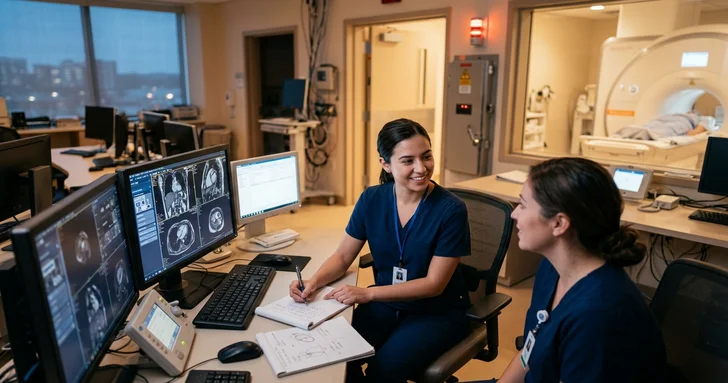
An MR Physicist specializes in the science, safety, and image quality of magnetic resonance imaging systems. Unlike an MRI technologist who operates the scanner to image patients day-to-day, the MR physicist evaluates the underlying hardware, software, and magnetic fields.
Typical daily responsibilities include:
Performing acceptance testing on newly installed MRI scanners and routine annual quality control for ACR and Joint Commission accreditation.
Measuring magnetic field homogeneity, RF coil performance, gradient linearity, and signal-to-noise ratios.
Developing and optimizing clinical pulse sequences to reduce scan time while maintaining diagnostic image quality.
Reviewing complex patient implant cases (deep brain stimulators, cardiac leads, metal hardware) to calculate RF heating risks and establish safe scanning parameters.
Teaching physics principles to radiology residents, imaging fellows, and MRI technologists.
Entering the field requires a Master's degree or Ph.D. in medical physics, physics, or biomedical engineering from a CAMPEP-accredited program, followed by a two-year clinical medical physics residency and board certification.
Frequently Asked Questions
Data Sources and Reference Periods
Salary figures, percentiles, and employment projections in this article are derived from official labor statistics and medical physics society reports. Federal wage data reflects the Bureau of Labor Statistics Occupational Employment and Wage Statistics (OEWS, May 2025 release) for SOC 19-2012 (Physicists). Ten-year employment growth projections are sourced from the BLS Occupational Outlook Handbook (2025–2035 projection period). Specialty clinical benchmarks and credential-based compensation data are drawn from the American Association of Physicists in Medicine (AAPM Professional Survey, Calendar Year 2024 analysis) and the American Board of Medical Physics (ABMP).
Frequently asked questions
The national median MR Physicist hourly wage is $82.81 per hour. Entry-level positions start around $39.48 per hour, while senior and board-certified clinical physicists regularly earn between $107.10 and $131.78 per hour.
An entry-level MR Physicist without board certification earns around $82,110 to $111,720 per year. Completing a clinical residency and passing Part 1 and Part 2 of board exams elevates starting clinical offers into the $150,000 to $180,000 range.
According to BLS wage reports, Florida leads the nation with a median physicist wage of $225,390 per year, followed closely by states with major medical research hubs including California, Arizona, New Mexico, and Massachusetts.
An MRI technologist is an allied health professional (typically holding an ARRT MRI technologist credential) who prepares patients and executes imaging protocols during patient visits. An MR Physicist holds a graduate degree (MS or Ph.D.), manages scanner calibration, oversees safety protocols, tests hardware, develops pulse sequences, and ensures regulatory compliance.
Yes. MR physics offers high earning potential, strong job security, and intellectually engaging work at the intersection of physics and medicine. With a projected 7% field growth and sustained demand from expanding hospital networks and MR-Linac installations, qualified specialists enjoy robust employment options.

Content manager
Erica Niklasson